
Upsc relevance- Mains ,GS Paper 1 – Indian Heritage & Culture
| Key facts for prelims from the article Vande Mataram written by Bankim Chandra Chatterjee (1875), published in Bangadarshan and later in Anandamath (1882). Bankim Chandra (1838–1894), pioneer of literary nationalism; works – Durgeshnandini, Kapalkundala, Anandamath, Devi Chaudhurani.Anandamath depicted ascetic patriots worshipping the divine motherland, symbolizing national awakening. Rabindranath Tagore set Vande Mataram to music and sang it at the 1896 INC session. Madam Bhikaji Cama (1907) unfurled the first tricolour with “Vande Mataram” at Stuttgart, Germany. On 24 Jan 1950, the Constituent Assembly gave Vande Mataram *equal honour with Jana Gana Mana. |
Why in news
November 7, 2025, marks 150 years of India’s National Song — Vande Mataram, meaning “Mother, I bow to thee.”
Written by Bankim Chandra Chatterjee and first published in Bangadarshan (1875), it was later included in his celebrated novel Anandamath (1882). The song, set to music by Rabindranath Tagore, became the heartbeat of India’s national identity — inspiring freedom fighters and uniting a diverse nation under one melody of devotion.
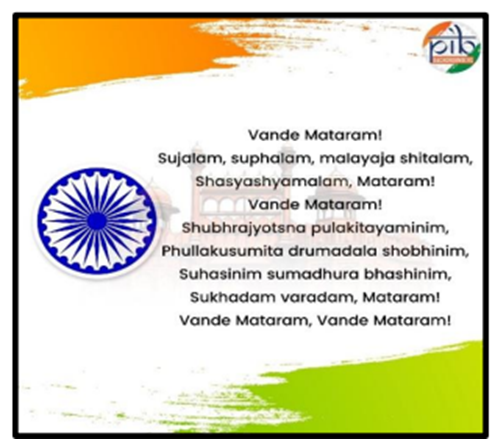
Historical Background
The evolution of Vande Mataram reflects India’s awakening from colonial subjugation — from a poetic hymn to a national rallying cry.
- 1875: First appeared in Bangadarshan. As per Sri Aurobindo’s 1907 article, the song gained importance as Bengal rose against British rule.
- 1881: Featured in the serialized novel Anandamath in Bangadarshan magazine.
- 1907: Madam Bhikaji Cama unfurled the first tricolour with “Vande Mataram” in Stuttgart, Germany — marking its global resonance.
Anandamath and the Religion of Patriotism
In Anandamath, Bankim Chandra envisioned patriotism as a form of worship.
The ascetics (Santanas) in the novel view the motherland as divine, symbolizing India’s spiritual and political awakening.
Three Forms of the Mother:
- The Mother that was – Glorious and powerful in the past
- The Mother that is – Enslaved and suffering under foreign rule
- The Mother that will be – Free, radiant, and resurgent
Sri Aurobindo later wrote that Bankim’s Mother “held trenchant steel in her seventy million hands” — representing strength and self-respect over helplessness.
Bankim Chandra Chatterjee: The Visionary
Bankim Chandra Chatterjee (1838–1894) was the architect of Indian literary nationalism and the pioneer of modern Bengali prose.
His major works — Durgeshnandini, Kapalkundala, Anandamath, and Devi Chaudhurani — embodied India’s search for identity and pride.
Through Vande Mataram, Bankim merged devotion with patriotism, giving India a vision of the nation as the Divine Mother — a source of strength, love, and liberation.
Vande Mataram – The Song of Resistance
By the early 20th century, Vande Mataram had transformed into the anthem of India’s resistance — igniting the Swadeshi and Anti-Partition movements.
Key Developments:
- 1905: Bande Mataram Sampradaya founded in North Calcutta; members held Prabhat Pheris (morning processions) singing the song — often joined by Rabindranath Tagore.
- 1906: Over 10,000 Hindus and Muslims united in the Barisal procession under the Vande Mataram flag.
- 1906: Launch of the Bande Mataram newspaper (Bipin Chandra Pal & Sri Aurobindo) — a fearless platform for nationalist thought.
- British Repression: Circulars banned the song in schools and offices, but instead of silencing it, the bans turned Vande Mataram into a symbol of defiance across India.
Battle Cry of Resurgent Nationalism
The song soon became the moral compass of India’s freedom movement, echoing across provinces and social strata.
Milestones in Its Journey
- 1896: Sung by Rabindranath Tagore at the Indian National Congress session.
- 1905: Became the anthem of the Swadeshi Movement.
- 1906: Formally adopted at the Varanasi Congress Session.
- 1907–1908: Heard in protests from Lahore to Tuticorin, during Tilak’s trial and various workers’ strikes.
- 1914: Pune streets thundered with “Vande Mataram” upon Tilak’s release from prison.
Essence: It became the heartbeat of India’s nationalism — blending courage, unity, and sacrifice into one chant of freedom.
Impact on Indian Revolutionaries Abroad
Vande Mataram transcended borders, inspiring revolutionaries worldwide and echoing in diaspora movements.
- 1907: Madam Bhikaji Cama unfurled the tricolour with “Vande Mataram” in Germany.
- 1909: Madan Lal Dhingra, before execution in England, uttered his last words — “Bande Mataram.”
- 1909: Launch of Bande Mataram magazine from Geneva, promoting Indian nationalism abroad.
- 1912: Gopal Krishna Gokhale welcomed in South Africa with chants of “Vande Mataram.”
This global echo reaffirmed the song’s status as a universal cry for Indian identity and freedom.
National Status (1950)
After Independence, the Constituent Assembly unanimously honoured both Vande Mataram and Jana Gana Mana as national symbols.
On 24 January 1950, Dr. Rajendra Prasad declared:
“The song Vande Mataram, which played a historic part in India’s freedom struggle, shall be honoured equally with Jana Gana Mana.”
- Jana Gana Mana – Official National Anthem
- Vande Mataram – Revered National Song
Both embody India’s freedom, unity, and moral spirit.
Conclusion
The 150-year commemoration of Vande Mataram celebrates its eternal role in shaping India’s national consciousness.
Born in the 19th-century literary renaissance, it became the anthem of resistance and unity, guiding India from subjugation to sovereignty.
Today, it continues to remind us that love for the Motherland is both sacred and transformative — a melody that forever binds the heart of India.
Prelims Practice Questions –:
Q1.Who composed the song Vande Mataram, which later became India’s National Song?
a) Rabindranath Tagore
b) Bankim Chandra Chatterjee
c) Aurobindo Ghosh
d) Bipin Chandra Pal
Correct: (b)
Q2.In which novel was Vande Mataram first included?
a) Kapalkundala
b) Anandamath
c) Devi Chaudhurani
d) Durgeshnandini
Correct: (b)
Mains Question:
Question: “Vande Mataram” is more than a song; it became a symbol of India’s struggle for freedom and national identity. Examine the historical evolution of Vande Mataram, its literary and cultural significance, and its role in fostering patriotism and unity during the freedom movement.(250 WORDS)
SOURCE-PIB