India–ASEAN Ties Making Steady Progress: The Century of Cooperation
UPSC Relevance-GS Paper 2: India and its Neighbourhood – ASEAN, Indo-Pacific Strategy, Bilateral & Multilateral Groupings.GS Paper 3: Economic Growth, Trade Policy, Maritime Security
Why in News
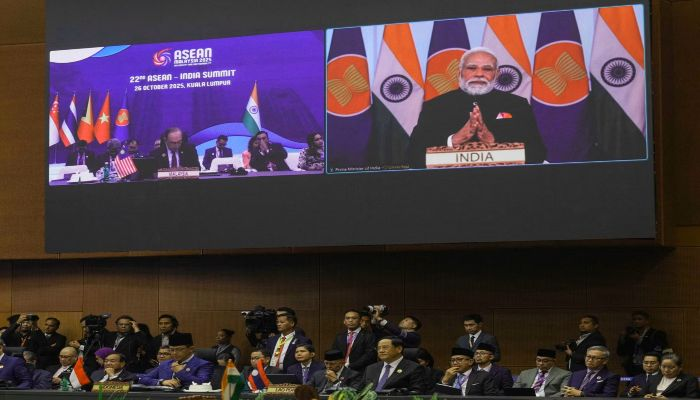
At the 22nd ASEAN–India Summit held in Kuala Lumpur, Prime Minister Narendra Modi reaffirmed that India–ASEAN relations are making steady progress despite the ongoing global uncertainties.
Delivering his address virtually, PM Modi announced that 2026 will be celebrated as the “ASEAN–India Year of Maritime Cooperation.”
Background: nABOUT –Association of Southeast Asian Nations (ASEAN) and India–ASEAN Partnership
The Association of Southeast Asian Nations (ASEAN) is a regional intergovernmental organization promoting political, economic, and social cooperation, as well as regional stability in Southeast Asia.
Establishment:
- Founded in 1967 in Bangkok through the ASEAN Declaration (Bangkok Declaration).
- Founding Members: Indonesia, Malaysia, Philippines, Singapore, and Thailand.
- Current Members (10): Brunei, Cambodia, Indonesia, Laos, Malaysia, Myanmar, Philippines, Singapore, Thailand, and Vietnam.
- Headquarters: Jakarta, Indonesia.
Institutional Structure:
- ASEAN Summit: Held annually to discuss regional issues and set policy directions, chaired by a rotating presidency.
- ASEAN Coordinating Council (ACC): Oversees the implementation of ASEAN agreements and decisions.
- ASEAN Secretariat: Provides administrative and technical support for ASEAN’s initiatives.
- ASEAN Regional Forum (ARF): Platform for political and security dialogue among ASEAN members and partners. (India joined ARF in 1996.)
Decision-Making:Based on consultation and consensus, ensuring equality among all members.
ASEAN Future Forum (2023):
- Proposed by Vietnam at the 43rd ASEAN Summit.
- Serves as a platform for members and partners to share ideas and policy recommendations.
- India is a founding member.
India–ASEAN Partnership
- India’s Engagement:
- Sectoral Dialogue Partner: 1992
- Summit-Level Partner: 2002
- Comprehensive Strategic Partnership (CSP): 2022
- Shared Vision:
Guided by a commitment to peace, stability, prosperity, and connectivity in the Indo-Pacific region. - Cultural and Civilizational Ties:
Prime Minister Narendra Modi describes ASEAN as India’s “cultural partner”, reflecting their shared heritage, ancient maritime trade routes, and civilizational linkages that go back centuries.
Key Announcements at the 22nd Summit
- ASEAN–India Year of Maritime Cooperation (2026) – To deepen collaboration in maritime security, disaster relief, and blue economy.
- Focus on Digital Inclusion – India will help ASEAN nations enhance digital public infrastructure, e-governance, and fintech connectivity.
- Resilient Supply Chains – India committed to creating trusted and diversified supply networks across the Indo-Pacific.
- Humanitarian and Disaster Relief Cooperation – India will continue to play an active role in HADR operations in Southeast Asia.
- Economic Integration through AITIGA – Both sides agreed to finalise the ASEAN–India Trade in Goods Agreement (AITIGA), which will boost trade and investment.
Economic Dimension: Trade and Connectivity
The ASEAN–India Trade in Goods Agreement (AITIGA), first signed in 2009, is being reviewed to make it more balanced and growth-oriented.
➤Significance:
- ASEAN is India’s 4th largest trading partner, accounting for ~11% of India’s total trade.
- India’s exports to ASEAN (2024): USD 44 billion, imports: USD 58 billion.
- Major trade items include electronics, petroleum products, agricultural commodities, and pharmaceuticals.
PM Modi said that the new AITIGA will “unleash the full economic potential” of India–ASEAN relations, strengthening value chains in the manufacturing and services sectors.
Maritime Cooperation: Pillar of the Indo-Pacific Vision
PM Modi’s announcement of 2026 as the Year of Maritime Cooperation reflects India’s Indo-Pacific strategy under the SAGAR doctrine (Security and Growth for All in the Region).
Key Focus Areas:
- Joint naval exercises and coordinated patrols to ensure freedom of navigation.
- Combating maritime piracy, illegal fishing, and trafficking.
- Marine research and sustainable ocean economy.
- Humanitarian assistance and disaster relief (HADR) cooperation.
Example: India has actively participated in the ASEAN-led ADMM-Plus Maritime Exercises, showcasing its growing strategic interoperability with Southeast Asian navies.
Shared Cultural and Strategic Values
- PM Modi emphasised that India and ASEAN together represent one-fourth of the global population, bound by shared civilisational values and historical maritime links.
- The Prime Minister reiterated that the 21st century belongs to India and ASEAN, highlighting their democratic ethos, youthful population, and innovation-driven economies.
Malaysian Prime Minister Anwar Ibrahim also reaffirmed that India–ASEAN ties are rooted in friendship, trust, and shared interests.
Developmental and Humanitarian Cooperation
India committed to working with ASEAN countries on:
- Food Security and Agriculture Innovation
- Health and Pandemic Preparedness
- Education and Skill Development
- Green Energy Transition
- Cybersecurity and Emerging Technologies
For instance, India’s Digital India stack and CoWIN model have been widely recognised by ASEAN nations as models for digital inclusion.
Challenges in India–ASEAN Relations
Despite progress, certain challenges persist:
- Trade Imbalance: India faces a trade deficit with ASEAN of over USD 14 billion.
- Connectivity Gaps: Projects like the India–Myanmar–Thailand Trilateral Highway face delays.
- Geopolitical Uncertainties: China’s growing influence in the South China Sea affects ASEAN’s unity and India’s engagement.
- Regulatory Barriers: Non-tariff measures and differing standards hinder deeper trade integration.
- Limited Awareness: Cultural exchanges and people-to-people contact remain underutilised.
Way Forward
- Expedite AITIGA Review for a fair and mutually beneficial framework.
- Enhance Maritime Domain Awareness through joint surveillance and information sharing.
- Promote UPI and Digital Payment Integration with ASEAN fintech systems.
- Invest in Connectivity Corridors under the Act East Policy.
- Encourage Academic, Youth, and Tourism Exchanges to deepen public diplomacy.
Conclusion
India and ASEAN together represent the future of the Indo-Pacific region — one built on stability, prosperity, and shared democratic values.
PM Modi’s assertion that “the 21st century is the century of India and ASEAN” captures the essence of this partnership: collaborative, inclusive, and future-oriented.
With enhanced maritime security, economic cooperation, and digital linkages, the India–ASEAN partnership is poised to become a cornerstone of regional order and global stability.
UPSC Prelims Practice Questions
Q1. The ASEAN Secretariat is located in:
A. Bangkok
B. Jakarta
C. Kuala Lumpur
D. Singapore
Answer: B
Explanation: The ASEAN Secretariat is headquartered in Jakarta, Indonesia, and coordinates ASEAN’s activities and implementation of agreements.
Q3. Which of the following statements is/are correct regarding ASEAN?
- ASEAN was established through the Bangkok Declaration of 1967.
- India is a founding member of ASEAN.
- The motto of ASEAN is “One Vision, One Identity, One Community.”
A. 1 and 3 only
B. 2 only
C. 1 and 2 only
D. 3 only
Answer: A
Explanation: ASEAN was formed in 1967 by the Bangkok Declaration. India is not a member — it is a dialogue partner. The official motto is indeed “One Vision, One Identity, One Community.”
UPSC Mains Practice Questions
- “The 21st century is the century of India and ASEAN.” Examine this statement in light of the evolving strategic and economic partnership.(10 Marks, 150 words)
- Discuss the role of maritime cooperation in deepening India–ASEAN relations and advancing India’s Indo-Pacific vision.(15 Marks, 250 words)
SOURCE-THE HINDU