How BRICS is Challenging SWIFT
UPSC Relevance
● GS Paper 2: International Relations – Global groupings and financial institutions
● GS Paper 3: Economy – Globalisation, Currency Systems, and Financial Inclusion
Why in News
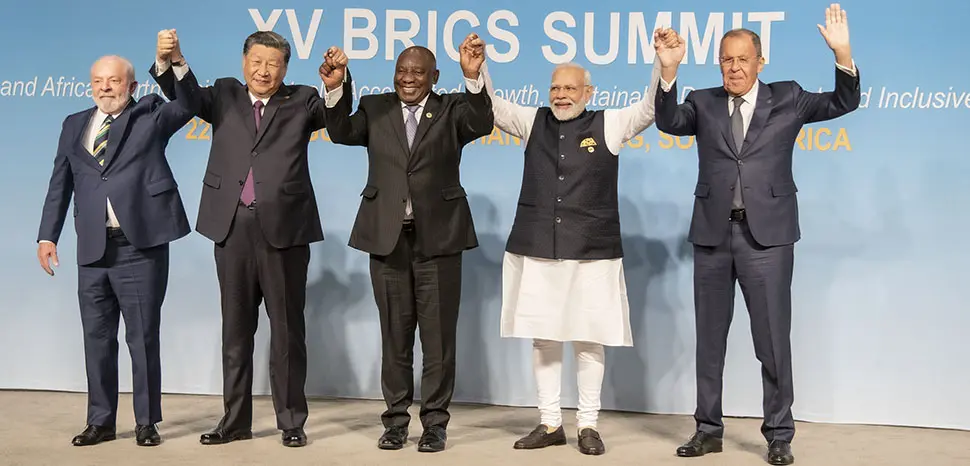
At the Kazan Summit 2024, BRICS nations (Brazil, Russia, India, China, South Africa — now including Iran and others) unveiled symbolic steps like a BRICS banknote and accelerated work on BRICS Pay, their cross-border payments initiative.These moves aim to reduce dependence on the dollar-dominated global financial system and challenge the SWIFT network, which has long been controlled by Western powers.
Background: From Fortaleza to Financial Sovereignty
The journey began at the Fortaleza Summit (2014), where BRICS launched two key institutions:
- The New Development Bank (NDB) – to finance infrastructure and sustainable development.
- The Contingent Reserve Arrangement (CRA) – to provide liquidity support during balance-of-payment crises.
These were the first major financial institutions led by developing countries, signaling a shift from Western financial dominance.
After Russia’s 2014 sanctions over Crimea, BRICS members started promoting use of national currencies in mutual trade to avoid the U.S. financial system’s leverage.
What is SWIFT?
SWIFT (Society for Worldwide Interbank Financial Telecommunication) is a global messaging system connecting over 11,000 banks in more than 200 countries.
It enables secure communication for international money transfers — but it does not move money itself.
Control: SWIFT is overseen by G10 central banks, including the U.S. Federal Reserve and the European Central Bank.
Problem: Its control allows Western countries to exclude nations (like Iran and Russia) through sanctions — effectively isolating them from the global economy.
Do You Know?
- When Russia was cut off from SWIFT in 2022 after invading Ukraine, its banks struggled to process even simple international trade payments.
- This incident accelerated BRICS’ push to create alternative networks like SPFS (Russia) and CIPS (China).
Challenging the Status Quo
The BRICS Cross-Border Payments Initiative (BRICS Pay) represents the most tangible attempt yet to bypass SWIFT.
Objectives of BRICS Pay:
- Reduce exposure to U.S. sanctions
- Enable settlement in local currencies
- Build a sovereign financial messaging network
The inclusion of Iran (2024) — a nation long targeted by Western sanctions — gave this initiative greater political and moral momentum.
At Kazan, the symbolic launch of a BRICS banknote drew global attention.
Former U.S. President-elect Donald Trump even threatened 100% tariffs on BRICS members if they “created a new BRICS currency or backed any currency to replace the dollar”.
Do You Know?
Fortaleza to Kazan: In just a decade, BRICS moved from establishing new financial institutions (NDB, CRA) to developing a cross-border payment alternative — an unprecedented shift in South-South financial cooperation.
Building BRICS Pay: The Emerging Architecture
The BRICS Payment Task Force (BPTF) is working to integrate the existing national systems of member countries:
| Country | Existing Payment Infrastructure | Key Feature |
| Russia | SPFS (System for Transfer of Financial Messages) | Alternative to SWIFT since 2014 |
| China | CIPS (Cross-Border Interbank Payment System) | Integrated with RMB globalisation |
| India | UPI (Unified Payments Interface) | Fast, mobile-based, interoperable system |
| Brazil | Pix System | Instant payments across Latin America |
A prototype of BRICS Pay was demonstrated in Moscow (Oct 2024).
Russia leads the effort, but other nations are cautious due to competing ambitions — India wants to globalize UPI, while China promotes CIPS to enhance RMB’s international role.
Challenges Ahead
- Interoperability Issues:Technical and regulatory coordination between UPI, CIPS, SPFS, and Pix remains complex.
- Divergent National Interests:
Each member seeks global dominance for its own payment system. - Geopolitical Pressure:
U.S. sanctions or trade retaliation (as threatened by Trump) could delay consensus. - Trust and Governance:
Ensuring fair participation without one country (like China) dominating will be crucial.
Significance of BRICS Pay
- De-dollarisation: Facilitates local currency trade settlements, reducing dollar dependence.
- Financial Sovereignty: Shields members from Western sanctions and payment disruptions.
- Inclusive Development: Offers developing nations an alternative financial network.
- Strategic Leverage: Creates a parallel financial architecture, enhancing BRICS’ geopolitical weight.
Do You Know?
If implemented successfully, BRICS Pay could connect over 3.5 billion people — nearly 45% of the global population — making it the largest alternative financial network outside the West.
Way Forward
- Develop Interoperability Standards:Harmonise national payment systems to ensure seamless transactions.
- Pilot Local Currency Settlements:Begin with bilateral pilot programs (e.g., India–Brazil, Russia–China) before scaling up.
- Strengthen Governance:Create a rotating secretariat or a joint digital payments authority for coordination.
- Build Confidence through NDB:Use the New Development Bank to support infrastructure for BRICS Pay adoption.
- Engage Global South Partners:Extend access to Africa, Latin America, and ASEAN countries seeking alternatives to SWIFT.
Conclusion
The BRICS challenge to SWIFT represents more than financial innovation — it is a symbol of a shifting world order.
While technical and political hurdles persist, the quest for financial autonomy among emerging powers could mark the beginning of a multi-polar monetary system — one where the Global South sets its own rules in the digital age.
UPSC Prelims Practice Questions
Q1. Consider the following statements regarding SWIFT (Society for Worldwide Interbank Financial Telecommunication):
- It is a global payment settlement system that directly transfers money between banks.
- It is controlled by central banks of the G-10 nations.
- Its headquarters is located in Belgium.
Which of the statements given above are correct?
(a) 1 and 2 only
(b) 2 and 3 only
(c) 1 and 3 only
(d) 1, 2 and 3
Answer: (b)
Explanation:
SWIFT is not a payment system; it is a messaging system that enables secure communication between financial institutions. It is controlled by G-10 central banks and headquartered in Belgium.
Q2. With reference to the New Development Bank (NDB), consider the following statements:
- It was established during the Fortaleza Summit of 2014.
- It aims to provide financing for infrastructure and sustainable development projects.
- Its membership is open only to BRICS nations.
Which of the statements given above are correct?
(a) 1 and 2 only
(b) 2 and 3 only
(c) 1 only
(d) 1, 2 and 3
Answer: (a)
Explanation:
The NDB was launched at the Fortaleza Summit (2014) to fund development projects. Its membership is open to all UN member states, not only BRICS nations.
Q3. Which one of the following correctly matches a BRICS country with its domestic payment system?
| Country | Payment System |
| 1. India | SPFS |
| 2. Russia | Pix |
| 3. Brazil | UPI |
| 4. China | CIPS |
Select the correct answer using the code given below:
(a) 1 and 4 only
(b) 2 and 3 only
(c) 4 only
(d) 4 only
Answer: (d)
Explanation:
- India → UPI
- Russia → SPFS
- Brazil → Pix
- China → CIPS
Only China–CIPS is correctly matched in the given options.
UPSC Mains Practice Question
Q. “The BRICS initiative to develop an alternative payment system like BRICS Pay represents a shift towards financial multipolarity.”Discuss how BRICS is challenging the SWIFT-dominated financial order and analyse its implications for the global financial architecture and India’s strategic interests.(250 words)