
UPSC Relevance; Prelims : Biosphere Reserves, MAB Programme, UNESCO, Sustainable Development, CNRE Scheme, Cold Desert Biosphere ReserveGS Paper 3: Environment, Conservation, Biodiversity, Climate Change
Why in News
On November 3, 2025, the world celebrated the International Day for Biosphere Reserves, recognising regions where nature and communities coexist harmoniously.
In India, the day highlights the nation’s extensive network of 18 biosphere reserves, spanning mountains, forests, coasts, and islands — demonstrating the country’s deep commitment to biodiversity conservation and sustainable development under the UNESCO Man and the Biosphere (MAB) Programme.
Background
Biosphere Reserves were conceived as “living laboratories” — testing grounds for balancing biodiversity conservation with human development.
The idea emerged under the UNESCO MAB Programme, established in 1971, to promote harmony between people and nature through science, education, and cooperation.
India joined this global effort by designating its first biosphere reserve, the Nilgiri Biosphere Reserve, in 1986.
Over time, these reserves have become models for climate resilience, sustainable livelihoods, and ecological protection across terrestrial, coastal, and marine ecosystems.
What are Biosphere Reserves?
A Biosphere Reserve (BR) is an area designated by the national government to conserve biodiversity while promoting sustainable resource use and community welfare.
They are often described as “learning places for sustainable development” — integrating scientific research, indigenous knowledge, and conservation planning.
Each biosphere reserve typically includes:
- Core zone: Strictly protected ecosystem with minimal human activity.
- Buffer zone: Surrounds the core and allows limited research or tourism.
- Transition zone: Outermost area supporting local communities and sustainable livelihoods.
Globally, over 260 million people live within biosphere reserves, which collectively protect 7 million sq. km — roughly the size of Australia.
| What is the difference between Biosphere Reserves and Biodiversity? Biodiversity is the entire variety of different kinds of life that can be found in one area including animals, plants, microorganisms. Biosphere Reserves are protected areas identified for conserving biodiversity and promoting sustainable development. These can include terrestrial, coastal, or marine ecosystems or a combination of these. |
UNESCO Man and the Biosphere (MAB) Programme
The MAB Programme provides the global framework for creating and managing biosphere reserves.
It combines natural and social sciences to address:
- Climate change and biodiversity loss,
- Ecosystem–society interactions,
- Sustainable development and education, and
- Environmental knowledge sharing.
Biosphere Reserves that meet MAB’s criteria are included in the World Network of Biosphere Reserves (WNBR), a dynamic global network of sites fostering collaboration and innovation.
The MAB International Coordinating Council (MAB-ICC) — comprising 34 Member States — serves as its main governing body.
Biosphere Reserves in India
India has 18 notified Biosphere Reserves, covering about 91,425 sq. km — roughly 2.8% of the country’s area. Of these, 13 are part of UNESCO’s WNBR.
The programme is administered by the Ministry of Environment, Forest and Climate Change (MoEFCC) under the Centrally Sponsored Scheme (CSS) for Biodiversity Conservation, a sub-scheme of the Conservation of Natural Resources and Ecosystems (CNRE) programme.
Funding Pattern:
- 60:40 between Centre and State,
- 90:10 for Northeastern and Himalayan states.
In 2025–26, the budget allocation doubled from ₹5 crore to ₹10 crore, indicating enhanced commitment to ecosystem protection.
Integration with National Schemes
India’s Biosphere Reserves operate in synergy with several flagship initiatives:
- Project Tiger (1973): Revived tiger populations through habitat conservation.
- Project Elephant: Protects elephants and mitigates human–elephant conflicts.
- Green India Mission: Enhances forest cover and carbon absorption.
- National Biodiversity Action Plan (NBAP): Regulates access to biological resources.
- Integrated Development of Wildlife Habitats (IDWH): Supports habitat restoration and community participation.
- Eco-Sensitive Zones (ESZs): Act as buffers to protect fragile ecosystems.
These interlinked programmes create a holistic conservation model, combining ecological preservation with socio-economic well-being.
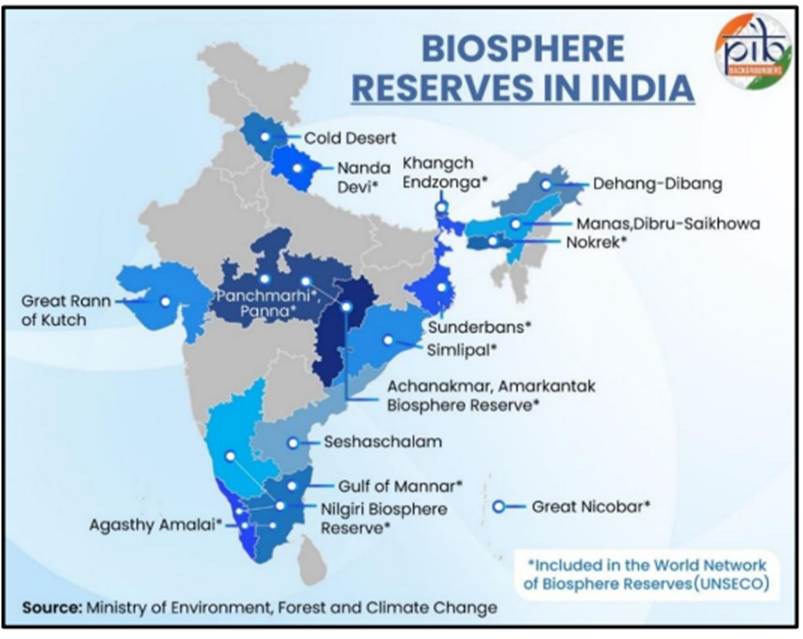
Key Facts
| Category | Biosphere Reserve | Location / Year |
| Largest | Great Rann of Kutch | Gujarat – 12,454 sq. km |
| Smallest | Nokrek | Meghalaya – 820 sq. km |
| Oldest | Nilgiri | 1986 |
| Newest | Panna | 2011 |
| Newest UNESCO Inclusion (2025) | Cold Desert Biosphere Reserve | Himachal Pradesh |
| States with Most BRs | Madhya Pradesh (3), Tamil Nadu (3) |
Impact and Achievements
India’s Biosphere Reserves have evolved into centres of excellence in conservation and sustainable living:
- Biodiversity Protection: Safeguard rare flora and fauna, supporting ecosystem balance.
- Climate Resilience: Enhance adaptation in fragile ecosystems through sustainable land use.
- Livelihood Security: Promote eco-tourism, organic farming, and alternate livelihoods.
- Improved Forest Health: India now ranks 9th globally in total forest area and 3rd in annual forest gain (FAO, 2025).
- Global Recognition: India’s growing presence in UNESCO’s WNBR underscores its leadership in conservation diplomacy.
Challenges Ahead
Despite progress, several issues persist:
- Human–wildlife conflict near buffer zones.
- Unsustainable resource extraction in transition areas.
- Limited funding and research infrastructure in some states.
- Need for greater coordination between central, state, and local bodies.
Addressing these will be crucial to achieving long-term ecological and livelihood security.
Way Forward
- Strengthen community-based eco-development and local governance.
- Encourage research–policy linkages to ensure adaptive management.
- Expand digital monitoring systems for forest and biodiversity data.
- Enhance climate integration — linking biodiversity goals with carbon sequestration.
- Promote international partnerships under UNESCO’s MAB to share innovations and best practices.
With growing investment and participation, India’s biosphere reserves can continue to serve as models of coexistence between humans and nature.
Conclusion
India’s observance of the International Day for Biosphere Reserves reflects its steadfast commitment to environmental stewardship and sustainable growth.
By combining scientific innovation, community participation, and policy coherence, India is setting global benchmarks in conservation.
As living examples of balance between people and planet, biosphere reserves are not just ecological zones — they are symbols of hope for a sustainable future.
Upsc prelims practice questions
Q1. With reference to Biosphere Reserves in India, consider the following statements:
- Biosphere Reserves are areas notified by UNESCO and come under international jurisdiction.
- They aim to promote a balance between biodiversity conservation and sustainable development.
- Each biosphere reserve typically includes core, buffer, and transition zones.
Which of the statements given above is/are correct?
(a) 1 and 2 only
(b) 2 and 3 only
(c) 1 and 3 only
(d) 1, 2 and 3
Answer: (b)
Explanation:
Biosphere Reserves are not under international control; they are designated by national governments. UNESCO only recognizes them under the Man and the Biosphere (MAB) Programme. Their structure includes core, buffer, and transition zones to integrate conservation with community development.
Q2. Consider the following pairs:
| Biosphere Reserve | Distinct Feature |
| 1. Nilgiri | First Biosphere Reserve in India |
| 2. Great Rann of Kutch | Largest Biosphere Reserve in India |
| 3. Nokrek | Smallest Biosphere Reserve in India |
| 4. Panna | Latest Biosphere Reserve to be designated |
How many of the above pairs are correctly matched?
(a) Only one
(b) Only two
(c) Only three
(d) All four
Answer: (d)
Explanation:All four pairs are correctly matched — Nilgiri (1986) was India’s first BR, Great Rann of Kutch is the largest, Nokrek (Meghalaya) is the smallest, and Panna (2011) is the newest.
Q3. The UNESCO Man and the Biosphere (MAB) Programme primarily aims to:
(a) Monitor only marine biodiversity within international waters.
(b) Promote the study of ecosystem–society interactions and sustainable development.
(c) Regulate trade in endangered species under the CITES framework.
(d) Establish uniform global laws on conservation.
Answer: (b)
Explanation:The MAB Programme integrates natural and social sciences to enhance human–environment harmony, promote research, monitoring, and create models for sustainable development.
Q4. Which of the following statements correctly describes the Centrally Sponsored Scheme (CSS) for Biosphere Reserves in India?
- It operates under the Conservation of Natural Resources and Ecosystems (CNRE) programme.
- The funding pattern is 60:40 for general states and 90:10 for Northeastern and Himalayan states.
- It is implemented by the Ministry of Jal Shakti in collaboration with State Forest Departments.
Select the correct answer using the code below:
(a) 1 and 2 only
(b) 2 and 3 only
(c) 1 and 3 only
(d) 1, 2 and 3
Answer: (a)
Explanation:The scheme is implemented by the Ministry of Environment, Forest and Climate Change (MoEFCC), not the Ministry of Jal Shakti. It provides financial support to states for biodiversity conservation and eco-development.
Q5. The Cold Desert Biosphere Reserve, recently included in the UNESCO World Network of Biosphere Reserves (2025), is located in:
(a) Ladakh
(b) Himachal Pradesh
(c) Sikkim
(d) Arunachal Pradesh
Answer: (b)
Explanation:In September 2025, the Cold Desert Biosphere Reserve of Himachal Pradesh was added to UNESCO’s World Network of Biosphere Reserves (WNBR), underscoring India’s growing global conservation role.
source-pib