
| UPSC Relevance GS Paper 3 (Economy): Growth, energy security, digital economy, PLI, semiconductor push. GS Paper 2 (Governance): Welfare delivery via DBT, inclusive growth, cooperative federalism. Essay: “Growth without equity is hollow”; “India’s economic churn: opportunities and challenges”. |
Why in News
India registered a 7.8% GDP growth in Q1 FY2025, among the fastest globally (MoSPI).S&P Global revised India’s sovereign credit rating outlook from stable to positive in May 2025, citing strong growth fundamentals.
- Major reforms in energy security, digitalisation, and semiconductor production are shaping India’s economic trajectory.
- As India aims for $5 trillion economy by 2027, debates on sustainability, inclusiveness, and energy transition have gained momentum.
Background: From Crisis to Renewal
1. 1991 Economic Crisis → Liberalisation and Global Integration
- In 1991, India faced a severe balance of payments crisis, with forex reserves barely enough to cover two weeks of imports.
- This forced India to adopt liberalisation, privatisation, and globalisation (LPG reforms).
- Outcome: The economy integrated with the global market, opening new avenues for trade, investment, and growth.
2. 2008 Global Financial Crisis → Testing Resilience
- The collapse of Lehman Brothers in 2008 triggered a worldwide financial crisis.
- Advanced economies like the US and Europe suffered deep recessions.
- India, however, remained relatively insulated due to:
- Strong domestic demand,
- Limited exposure of Indian banks to risky foreign assets.
Outcome: India maintained positive growth, proving its economic resilience.
3. 2020 COVID-19 Pandemic → Sharp Contraction, Rapid Recovery
- The nationwide lockdown caused a sharp contraction in GDP in 2020.
- But recovery was faster compared to peers because of:
- Atmanirbhar Bharat package, which supported industries and vulnerable sections.
- Rapid digital penetration (UPI, digital platforms) that kept the economy running even during restrictions.
Outcome: India’s recovery was stronger than many developed nations.
4. Current Moment (2020s) → Not a Crisis, but Renewal
Unlike earlier disruptions, today’s churn is not about survival, but about renewal and transformation.Drivers of this renewal include:
- Digital reforms (UPI, Aadhaar, GST, ONDC).
- Infrastructure push (roads, railways, ports, renewable energy).
- Energy diversification (solar, green hydrogen, EVs).
- Geopolitical positioning (India as a trusted partner in a multipolar world).
In simple terms: Past crises forced India to change. But now, India is using this period of global churn to reinvent and strengthen itself proactively.
Current Economic Performance
1. GDP Growth
- According to the Ministry of Statistics and Programme Implementation (MoSPI), India recorded 7.8% GDP growth in Q1 FY2025.
- This continues India’s streak as the world’s fastest-growing major economy, even amid global economic slowdown.
👉 Strong growth reflects domestic demand resilience and the impact of structural reforms.
2. Gross Value Added (GVA)
Growth is broad-based across all sectors:
- Agriculture: Despite climate stress, steady growth due to foodgrain output and rural demand.
- Manufacturing: Boost from PLI schemes, Make in India push, and rising export competitiveness.
- Services: IT, financial services, tourism, and logistics showing strong expansion.
👉 This indicates that recovery is not dependent on just one sector, but is balanced and diversified.
3. Global Comparison
India’s growth clearly outpaces global peers:
- China: Growth has slowed to below 5%, due to property market crisis and weak consumption.
- Advanced economies (US/EU): Hovering at 1–2%, impacted by inflation, energy shocks, and tight monetary policy.
👉 India stands out as a growth engine of the global economy, attracting investors and global supply chains.
4. FDI & Markets
Net FDI inflows stood at $32 billion in FY2024, showing sustained global investor confidence despite geopolitical volatility.
Indian equity markets (Sensex, Nifty) touched record highs, reflecting:
- Optimism over growth prospects,
- Stability in macroeconomic indicators,
- Rising retail participation in markets.
👉 Both FDI and market performance highlight confidence in India’s long-term economic story.
Energy Security: The Cornerstone of Growth
1. High Energy Demand
- India is the world’s 3rd largest energy consumer, after China and the U.S.
- According to the International Energy Agency (IEA), India’s energy demand is projected to grow at ~3% annually till 2040.
- This growth is driven by:
- Expanding urbanisation,
- Rising industrialisation,
- Increasing per capita energy use as incomes rise.
👉 This makes energy central to sustaining India’s GDP growth.
2. Oil & Gas: Traditional Backbone
Domestic Exploration:
- Through the Open Acreage Licensing Policy (OALP), firms like ONGC and private players are exploring deepwater reserves.
Russian Oil Imports:
- After the Ukraine war, India diversified by importing discounted Russian crude.
- Benefit: Cheaper oil → lower import bill & inflation control.
- Concern: Geopolitical pressure from the West (esp. U.S. & EU).
👉 Shows India’s energy pragmatism—balancing economics with geopolitics.
3. Renewable Energy Push
India has set ambitious green energy targets:
- 500 GW non-fossil fuel capacity by 2030.
- Rapid growth in solar and wind capacity → India among the top 5 globally.
Biofuels:
- 20% ethanol blending by 2025 (already 15% in 2024, as per MoPNG).
Reduces oil import dependency and supports farmers.
👉 Renewable expansion ensures a cleaner, diversified energy basket.
4. Challenges
Import Dependence: India still imports 85%+ of crude oil, making it highly vulnerable to global price shocks.
Affordability vs. Green Transition:
- Fossil fuels are cheaper in the short run, but unsustainable.
- Renewable infrastructure requires high upfront investment.
Grid Integration: Managing variable renewable sources (like solar/wind) remains a challenge.
👉 India must carefully balance growth needs with climate commitments.
Reforms & New Growth Engines
1. Digital Economy: India’s Transformation Driver
UPI Revolution:
- In 2025, UPI transactions crossed 14 billion per month, reflecting deep digital penetration.
- Example: Even street vendors now accept QR payments.
Aadhaar + DBT:
- Direct Benefit Transfer linked with Aadhaar ensures 40+ crore beneficiaries get subsidies/welfare without leakages.
- Example: LPG subsidy, PM-Kisan, pension payments.
India Stack Export:
- Countries like Philippines, Singapore are adopting India’s digital model.
- India is emerging as a global leader in digital public infrastructure.
2. Semiconductor Mission: Building Tech Self-Reliance
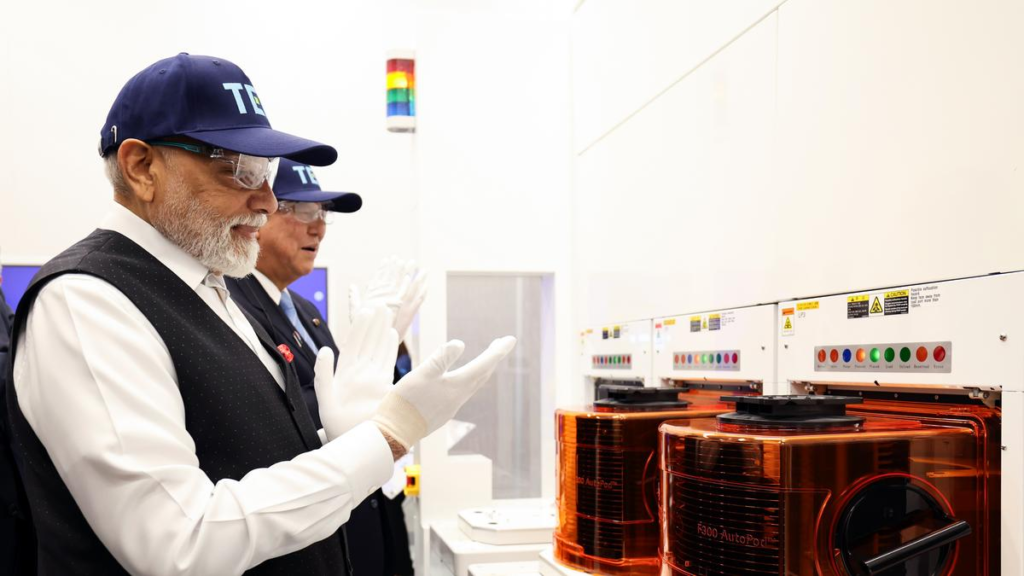
- India Semiconductor Mission (ISM): $10 billion incentive package for chip manufacturing.
- Micron’s $2.7 billion plant in Gujarat (construction started 2024) is a flagship investment.
Why important?
- Semiconductors are the “oil of the digital age.”
- India currently imports most chips → dependence on East Asia (Taiwan, South Korea).
3. Infrastructure & Logistics: Foundation of Growth
- PM Gati Shakti: National Master Plan integrating rail, road, ports, airports, and pipelines on a single digital platform.
- Current challenge: Logistics cost in India is 13–14% of GDP (vs 8–10% in China).
- Aim: Bring costs down → improve competitiveness of exports and manufacturing.
- Example: Faster freight corridors, port connectivity, EV charging infra..
4. Production Linked Incentive (PLI): Boosting Manufacturing
- PLI covers 14 key sectors like electronics, textiles, pharma, and EVs.
- Success case: Mobile exports crossed $16 billion in FY2024 (Apple, Samsung shifting production to India).
- Target: Raise manufacturing share of GDP (currently ~17%) closer to 25% by 2030.
Social Inclusion & Poverty Reduction
- Poverty Decline: NITI Aayog (2024) estimated 13.5 crore people exited multidimensional poverty between 2015-2021.
- PMGKAY free ration benefitted 81 crore people during COVID and continues for food security.
- Health & Education: Ayushman Bharat, NEP 2020 reforms addressing inclusivity.
However, inequality remains stark:
- Oxfam Report 2023: Top 10% hold 77% of wealth.
- Need for equitable distribution of gains.
Key Challenges Ahead
1. Energy & Environment
Coal Dependence:
- Even though India is investing in solar, wind, and green hydrogen, coal use is still rising to meet power demand.
- Example: Peak summer power shortages in 2024 forced higher coal imports.
Air Pollution Costs:
- World Bank estimates: Air pollution costs India ~8.5% of GDP annually (healthcare + productivity loss).
- Example: Delhi NCR’s smog → higher respiratory diseases, flight cancellations, lower work productivity.
2. Geopolitical Risks
Russian Oil Dependence:
- After the Ukraine war, India buys cheap Russian crude (saving billions).
- But → risk of Western sanctions and over-reliance on one source.
Global Supply Chains:
- Exports face uncertainty due to shipping disruptions (e.g., Red Sea crisis, Taiwan tensions).
Example: Textile exports hit when US/EU demand slowed.
3. Human Capital Deficit
Skill Gap:Only 4.7% of workforce is formally skilled (MSDE 2023).
Compare: South Korea (96%), Japan (80%).
Education Quality:
Learning outcomes remain weak.
Example: ASER reports → many Class 5 students struggle with Class 2 math.
4. Fiscal Pressure
- High Subsidy & Welfare Spending:
Food, fertilizer, and fuel subsidies are necessary but eat into government resources. - Fiscal Deficit:
FY2025 Budget Estimates (BE): 5.1% of GDP.
High borrowing = less fiscal room for infra, education, or health spending.
Way Forward
1. Balanced Growth
Manufacturing + Services Synergy:
- India must not depend only on IT/Services. Manufacturing (via PLI, Make in India) should complement services to generate large-scale jobs.
- Example: Mobile exports ($16B in FY24) show how manufacturing can add to IT-enabled services.
MSME Strengthening:
- MSMEs contribute 30% of GDP & 48% of exports but face credit and tech gaps.
- Digital credit platforms + easier GST compliance can unlock their growth.
2. Green Transition
Clean Energy Push:
- Faster adoption of solar, EVs, and green hydrogen (500 GW non-fossil fuel target by 2030).
- Example: India’s ethanol blending already reached 15% in 2024 vs target of 20% by 2025.
- Carbon Pricing & Incentives:
Introduce carbon markets + green tax incentives for industries shifting to renewables. - This aligns with India’s net zero 2070 pledge.
3. Inclusive Policies
Rural Infrastructure + Skilling:
- Focus on rural connectivity, storage, and logistics for agri-value chains.
- Skilling youth through PMKVY & apprenticeship models.
Gender-Balanced Workforce:
- Female Labour Force Participation is just 37% (PLFS 2023).
- Policies like childcare support, flexible work, and women-led SHGs can improve participation.
4. Institutional Strengthening
Judicial, Regulatory, Financial Reforms:
- Faster dispute resolution (commercial courts, arbitration).
- Banking sector reforms for better credit flow to infra & MSMEs.
Cooperative Federalism:
- States need more say in resource allocation (e.g., GST Council as a success model).
- Example: Energy transition funds should empower coal-dependent states like Jharkhand & Chhattisgarh.
Conclusion
India’s economic churn is a moment of renewal, not crisis. With strong fundamentals, demographic dividend, and digital infrastructure, India has the chance to transition into a resilient, inclusive, and green growth model. The challenge lies in balancing energy security with sustainability, growth with equity, and global integration with self-reliance. If addressed holistically, the current churn will indeed be the nectar of growth for India’s future.
Upsc mains practice question-
Q. The phrase “Economic Churn as the Nectar of Growth” captures India’s trajectory of transforming crises into opportunities. Examine this statement with reference to recent economic performance indicators and structural reforms. (15 marks)
SOURCE- THE HINDU
Found this helpful?
Bookmark for revision, Practice the mains question, and
Share with fellow aspirants! THANK YOU