
UPSC Relevance
Prelims-Facts on TB transmission, risk factors, diagnostic tools, NTEP, Ni-Kshay schemes, MDR/XDR-TB, and India’s TB elimination targets.
Mains (GS-II & GS-III)-Issues of health governance, service delivery, and social protection.
Why in News
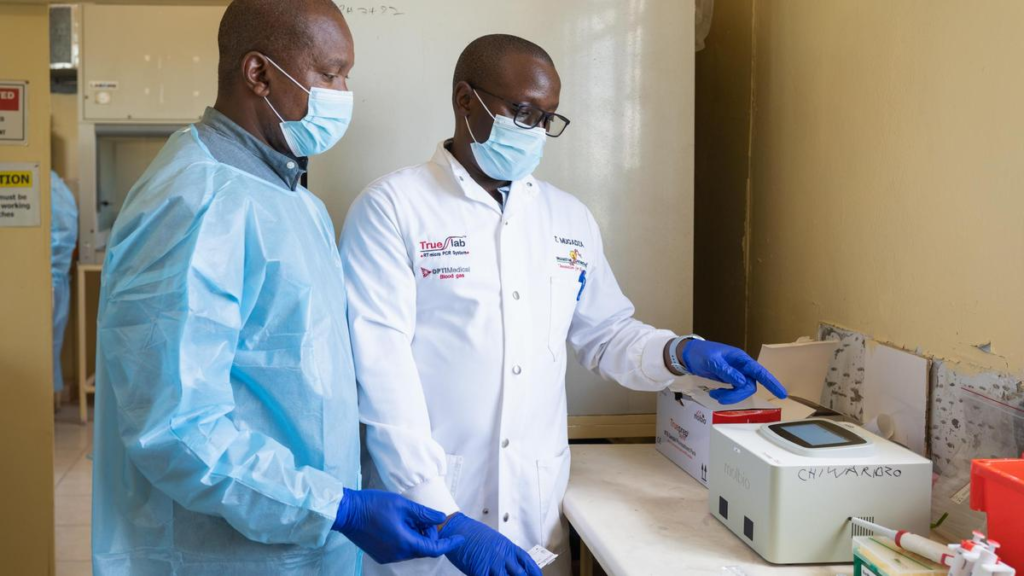
India’s portable molecular diagnostic systems — especially battery-operated PCR devices — have gained international recognition for cutting TB detection time and improving drug-resistance diagnosis. These innovations are now being discussed globally as models for scalable TB control in low-resource settings.
Background
For decades, TB detection depended on:
- Sputum Smear Microscopy — cheap but low sensitivity.
- Culture Tests — accurate but take 4–8 weeks.
This delay caused uncontrolled transmission and high mortality.
The introduction of portable point-of-care PCR machines changed the landscape. They detect TB + drug resistance in less than an hour, and are now widely used under the National TB Elimination Programme (NTEP).
India’s Changing Approach to TB Control
1. Decentralised Diagnostics
India rapidly deployed:
- NAAT-based tests (e.g., Truenat, CBNAAT)
- AI-enabled digital X-rays
This expansion has:
- Reduced diagnostic delay
- Enabled same-day treatment
- Improved drug-resistant TB (DR-TB) detection
These affordable portable devices are now used in sub-Saharan Africa, Southeast Asia, and refugee camps, projecting India as a global health technology leader
2. National TB Elimination Programme (NTEP)
Goal: Eliminate TB in India by 2025 (global target: 2030)
Guided by National Strategic Plan (NSP) 2017–25 —
Detect → Treat → Prevent → Build.
Key pillars:
- Integration of private hospitals
- Screening of high-risk groups
- Social protection + nutrition support
- Modern, shorter treatment regimens
Key Achievements (Latest Data)
Case Detection
- 26 lakh TB notifications (2024) — highest ever.
Incidence Decline
- 18% reduction between 2015–2023
(Global average: ~8%).
Mortality Decline-21% fall (28 → 22 deaths per lakh).
Treatment Coverage~85% patients receiving full treatment.
India’s Response to Drug-Resistant TB
- Shift to all-oral Bedaquiline-based regimens.
- Adoption of mBPaL regimen for MDR-TB → ~80% success rate (global average ~60%).
- Strengthened Drug-Susceptibility Testing (DST) network.
Why this matters: DR-TB is expensive, hard to treat, and spreads silently. India treating it effectively influences global trends, because India accounts for 27% of global TB burden.
Major Government Initiatives
Pradhan Mantri TB Mukt Bharat Abhiyaan (PMTBMBA)
World’s largest community-driven TB nutrition movement.
Key components:
- Ni-Kshay Mitra: 2.55 lakh volunteers providing food baskets.
- Ni-Kshay Poshan Yojana: DBT for nutrition → 1.28 crore beneficiaries; support increased to ₹1,000/month.
100-Day TB Mukt Bharat Campaign
- 12.9 crore people screened
- 7.19 lakh cases detected, many asymptomatic
Why important: Early detection breaks the chain of transmission.
TB: Key Facts for UPSC- prelims
- Causative agent: Mycobacterium tuberculosis
- Transmission: Airborne droplets
- Risk of disease: Only 5–10% infected people develop active TB
- Major risk factors: Malnutrition, HIV, diabetes, tobacco
- Standard treatment: 4–6 months (first-line regimen)
- MDR-TB: Resistant to Isoniazid & Rifampicin
- XDR-TB: MDR + resistant to key second-line drugs
- HIV patients: ~16 times more vulnerable
Challenges in TB Elimination
1. Malnutrition & Poverty
- Malnutrition contributes to ~40% of TB cases in India.
- TB spreads fastest where people live in crowded, poorly ventilated spaces.
2. Missed Diagnosis
- Symptoms resemble flu or common cough.
- Women face stigma and mobility issues, reducing testing.
3. Stigma & Social Exclusion
- Patients hide disease → delayed diagnosis → community spread.
- Homeless and migrants lack access to facilities.
4. Childhood TB-Hard to diagnose due to low bacterial load and difficulty in producing sputum.
5. MDR-TB-Rising due to irrational antibiotic use and unregulated private sector.
6. Implementation Gaps
- Delayed DBT payments
- Workforce shortage
- State-wise uneven performance
- Poor follow-up in urban slums, tribal belts
Technology & Innovation in TB Control
India now uses:
- AI-based X-rays for mass screening
- Portable NAAT machines for remote areas
- Ni-Kshay Portal → real-time patient tracking
- Video-DOTS & SMS tools → adherence
- GIS mapping → hotspot identification
These innovations reduce human error and speed up disease control.
Global Context
- India is a key driver of WHO’s End TB Strategy.
- Indian diagnostic devices are exported to 20+ LMICs.
- India participates in clinical trials for new vaccines:
- M72/AS01E
- MTBVAC
These could become game-changers in the next decade.
Targeted Interventions Needed
- Include homeless populations as an official ‘vulnerable group’.
- Mandatory TB screening in mines, factories, construction sites.
- Strengthen nutrition via DBT + community support.
- Expand NAAT machines in underserved rural blocks.
- Provide mental health support to reduce stigma and depression.
- Improve urban surveillance among migrants & slum populations.
- Strengthen childhood TB detection with stool-based NAAT tests.
A Call for Continued Investment
Diagnostics alone cannot eliminate TB.
India needs integrated action on:
- Nutrition
- Vaccines
- Digital adherence tools
- Contact tracing
- Community engagement
This ensures “No patient left behind.”
Conclusion
India has made remarkable progress — faster diagnostics, reduced incidence, improved drug-resistant TB management, and strong community participation.
But to truly eliminate TB, India must:
- Target vulnerable groups
- Strengthen state-level implementation
- Invest consistently in nutrition + diagnostics
- Tackle stigma and inequality
TB is not just a disease of bacteria — it is a disease of inequality.
Eliminating it requires addressing both medical and social determinants together.
UPSC Prelims Practice Questions
Q1. Which of the following statements about tuberculosis (TB) are correct?
- TB is caused by a bacterial infection and is transmitted primarily through the air.
- Only symptomatic individuals can transmit TB.
- Malnutrition is one of the major risk factors for TB in India.
- HIV patients are more susceptible to developing active TB disease.
Choose the correct answer:
a) 1 and 3 only
b) 1, 3 and 4 only
c) 2 and 4 only
d) 1, 2, 3 and 4
Correct Answer: b)
Statement 2 is incorrect: asymptomatic individuals with latent TB do not infect others, but active TB patients can transmit.
Q2. Consider the following pairs:
Government Initiative — Objective
- Ni-Kshay Poshan Yojana — Direct financial support for nutrition of TB patients
- Ni-Kshay Mitra — Community adoption and support for TB patients
- mBPaL Regimen — Long-term injectable-based treatment for MDR-TB
Which of the above pairs is/are correctly matched?
a) 1 and 2 only
b) 2 and 3 only
c) 1 and 3 only
d) All three
Correct Answer: a)
Pair 3 is incorrect: mBPaL is a shorter, all-oral regimen, not injectable.
UPSC Mains Practice Question
GS-II / GS-III (Health)
Q“Despite major technological and programmatic improvements, tuberculosis (TB) in India remains a disease of inequality.” Discuss the key challenges in TB elimination and evaluate how India’s recent innovations and policy reforms can address both medical and social determinants of the disease. (Word limit: 250)
SOURCE- THE HINDU